Showing posts with label TpT. Show all posts

Sunday, August 3, 2014

New job, new standards!

As I mentioned previously, I am shifting from elementary to early childhood.  One of the big shifts for me will be in my goal writing.  I've been using my Common Core Goal Matrix as a handy one page reference for writing goals.  Of course, I can still use it for my kids going into Kindergarten, but I have to learn a new set of standards, as well.

In Illinois, we have the Illinois Early Learning and Development Standards, which was revised in 2013 to align with not only the Early Intervention Standards for the state, but also Common Core.  The document itself has a lot of GREAT information, and each standard is broken down into three benchmarks that build on each other until "mastery".  Unfortunately, it's also 134 pages long.

At my meeting on Friday, I learned that our district gives parents the option of what my coordinator calls a "trifecta" meeting.  If the team feels further evaluation is needed after an evaluation, parents are given the option to hold the domain, evaluation, eligibility review and IEP all in the same day.  We have about 30 minutes between the end of the eval and the start of the eligibility review to enter our evaluation report and develop goals if necessary.  Needless to say, I'm going to need a good TPBA report template for myself to help streamline!

The other thing I quickly realized I'll need is a way to organize the standards so I can write goals that align with them.  This summer, I got a glance of our new criteria for evaluation that my district will be using.  Posting learning objectives is one of the requirements.  

The first thing I did was list all of the English Language and Social/Emotional Development standards on one sheet.  
Now you can see why this is 134 pages!
 
Whew!  It's certainly a handy document to have, but it doesn't really break down the standards, and it isn't organized by goal areas quite the way I'd like it to be.  We know as SLPs, standards for some of the areas we work on are easier to find than others.  For example, unlike in the Common Core Standards, speaking clearly is only in an overall goal area, not in any specific objective- which means I have to find the best fit for goal areas like phono/artic and fluency.  There are some great objectives related to game play (I called it cooperating, because while I know learning how to play games is a big thing for many of my students, I cringe to think of the administrator wandering through my room and my objective being, "playing a game").  I also included objectives for increasing independence, pretend play, and shared/joint attention, including the staples of following directions, grammar, asking and answering questions, listening comprehension, retelling, pragmatics, artic/phono, and fluency. There are a total of 21 objectives.

Since everything in the CCSS world is in "I can" statements, that's the format I stuck with.  Parents are going to be introduced to them in kindergarten, and if the student has an older sibling, they probably already have exposure to it.  

There are 21 objectives in total in the areas of increasing independence, pretend play, shared/joint attention, following directions, grammar, asking and answering questions, listening comprehension, retelling, pragmatics, artic/phono, fluency. "I can" statements in kid-friendly language based on the information provided in the standards. The relevant standards are in the bottom right corner.
 I'm still not confident about my office location, so for right now, I plan on printing these out and putting them in sheet protectors secured with binder rings so I can easily flip through.  I'm also planning on printing 4 to a page, laminating, cutting apart, and securing with a binder ring for a to-go pack that I can bring with me in the classroom or to meetings.

If you do purchase this product and would like to see a goal area not included, please just let me know, and I will do my best to accommodate!

I tried to minimize color on this one, but if you are a person who goes for black and white, that's an option, too.  

http://www.teacherspayteachers.com/Product/Illinois-Early-Learning-and-Development-Standards-for-Posting-in-the-Classroom-1367900

Both products will be on sale during the big TpT back to school sale.  The color one can be found here, and here's the link to the black & white version.

I hope that if you serve the population I do, this will be helpful to you!

Thursday, July 31, 2014

What's in my cart? Link up for the TpT sale!

A new age group means I am hunting for new materials.  What a great time for a TpT sale!  In case you haven't heard, Teachers Pay Teachers is hosting a sale August 4th-5th.  


300 × 250


I'm linking up with Speech Room News to tell you all what's in my cart for my Early Childhood kids.  I am really excited about these great finds!

http://thespeechroomnews.com/2014/07/whats-in-your-cart-linky-party-2.html


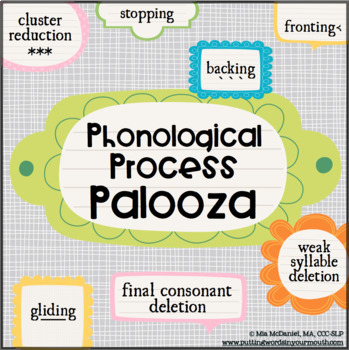
1.) Phonological Process Palooza! from Mia McDaniel.  I must say, I LOVE LOVE LOVE Mia's products.  They are always thoughtful, versatile, and pretty low prep.  I am a big fan of her Quick Drill games (all of my kids were gaga for them last year!), and her co-articulation binders?  C'est magnifique!  My late elementary students also loved her iPhone inferencing activity- it was a great challenge!  But enough of me singing her praises. Let's talk Palooza.


http://www.teacherspayteachers.com/Product/Phonological-Process-Palooza-fun-therapy-activities-for-common-processes-1257946
What I love is the number of targets in this packet and the fact that it's multiplied by SEVEN processes.  Also, the use of pictures, which is essential with my 3-5 year old population.  I can easily see working on this with some of my kids and using sheets for home practice, too!  Tons of opportunities for productions.  I'm ready to pick up my pencil and start jotting data!


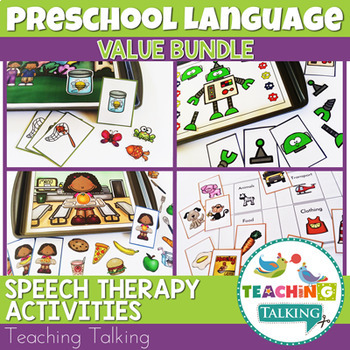
2.)Preschool Speech Therapy Activities: Big Value Bundle! by Speech Therapy Games.  OK, so this one could be sort of a doozy, in terms of both pricing and prep commitment.  HOWEVER, I am walking into an office that was literally stripped bare.  I am starting from scratch, and boy howdy, this VERY thorough bundle hits about 80% of my kids goals.  Add in the home practice sheets, and I'm pretty sold.  


http://www.teacherspayteachers.com/Product/Preschool-Speech-Therapy-Activities-Big-Value-Bundle-1230464


The bundle is a combination of EIGHT different packets - pronouns, asking & answering questions, plurals, possessive -s, basic concepts & prepositions, adjectives & describing, verbs & sentence structure, and practical vocabulary building.  Sound familiar?  This is why it's in my cart!  

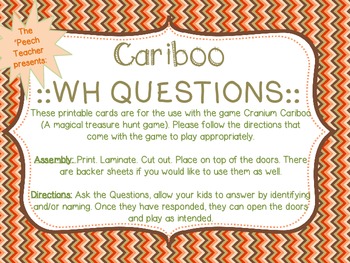
3.) Cariboo Wh- Questions: Who, What, and Where by The 'Peech Teacher.  I was first introduced to Cariboo in grad school.  Before it was cool to save things for later use and put them on TPT, I made a series similar to this.  My clients LOVED it.  


I so appreciate that I don't have to reinvent the wheel here.  In fact, it has separate sets for each type of WH- question, so I can target one at a time, or mix them up, depending on student level.  Bonus: it's all picture based in regards to what the kids actually see. Score!

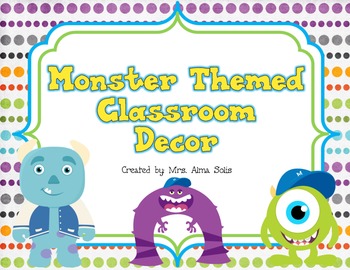
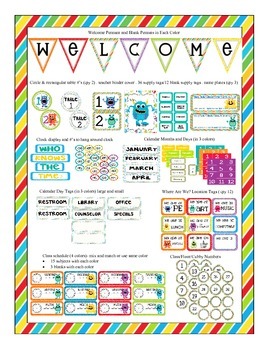
4.) The building theme this year is college readiness.  Each classroom is taking a college or university, and those of us in related services are allowed to pick our own.  Early childhood went with Monster University as their theme, and I am tempted to jump on board!  Because how cute are these monster themed classroom decor bundles?
http://www.teacherspayteachers.com/Product/Monster-Themed-Classroom-Decor-889108http://www.teacherspayteachers.com/Product/Monster-Themed-Classroom-Bundle-774305


Those are my big purchases this go-around, I think.  What about you?

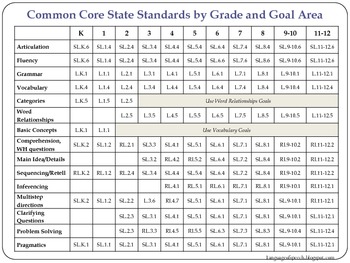
If you are an SLP who uses the Common Core Standards for goal writing, I encourage you to pick up my product, Common Core State Standards for Speech Language Pathologists.  It's meant to help you find applicable goals based on a goal area and grade level for quick reference to the standards.  I'm pretty bummed that I have to retire mine until next spring when my preschoolers head to kindergarten. My state has separate standards for Early Childhood, so I'll have to create my own new cheat sheet!


http://www.teacherspayteachers.com/Product/Common-Core-State-Standards-for-Speech-Language-Pathologists-368473


 What's in your cart?  Am I missing any Early Childhood must-haves?


Tuesday, February 25, 2014

What I Wish For...

By now, you've probably heard about the big 3 Million Teachers sale on TpT.  I am super excited about whittling down some of my wishlist!


1. No Print I "Mustache" You a Question: Answering and Formulating Questions by Sublime Speech.  What a versatile product for my K-2 crowd!  And no-print, which is great these days!

2. Speech and Language Common Core Cans by Nicole Allison of Speech Peeps.  I love the idea of exit questions. Great thing to do in the last few minutes of a session.


3. Conversation System: Visual Guide and Scoreboard by Kate Shepard. I am always on the lookout for activities that will help my social language kids.  Rubrics have been awesome for some of my students that have the fundamental skills and are working on carryover, but for those that are still working on those fundamental skills, I am excited to try something more visual.


I also have some clip art that I am excited for, but hopefully that will appear at a later time when I actually have time to make some new products!

In the meantime, check out Speech Room News, who is hosting another What's in Your Cart linky party to see what your other favorite bloggers have in their carts!

Saturday, August 17, 2013

Back to School Shopping


You've heard about the TpT sale that starts tomorrow, right? Because it does. And I could not be more pleased.  I have been quietly adding to my wishlist (OK, so the last few weeks have been more in the "frantic" realm) as I read over student goals, and start to think about how I am structuring this year.  One of the big things I am thinking about is homework.  Homework that will actually get done, is relevant, and maybe, just maybe, might be a little bit of fun, too.  I am inspired by a homework post I read recently that sends home games and activities with the students to help facilitate speech and language at home. I have many articulation bingo cards that I inherited from the SLP who retired before I was hired, but Bingo will only get me so far.  Here's what I'm thinking right now:

1. Quick Drills from Mia of Putting Words In Your Mouth. How cute are these?  The concept is simple, the price is certainly right, and there's a little something for everyone (everything from sports to flip flops to Star Wars!), along with word lists for multiple sounds.  How easy would it be to practice with a student and then send it home so they can show off to their folks?  Just print, laminate, cut, and go.

2. Silly Stories Articulation - s, th, l, ch, sh, j and /r/ & vocalic-r from Speech2U.  These are mad-libs lists by sound.  Neat for some of my reading-level kids. Easy enough to send home a mad-lib story and have the students practice.

3. Speech and Language Homework for a Year and Social Language Homework for a year by If Only I Had Super Powers. Talk about thorough!  A great supplement, and great examples for parents of opportunities they could take to help their student target their goal areas.  And so easy to organize for sending home, which is much appreciated.

Since not everything can be homework, here are some of the other things I have been coveting lately:

1. Secret Agent Articulation by Jenna of Speech Room News.  My students go crazy for QR codes, and love them to bits.  What a great way to incorporate something fun with articulation AND a little vocabulary building. 

2. Idiom of the Week from Speech with Sharon.  My recent office move has put me smack dab in the middle of a hallway that every student passes at least four times a day.  Since my door is in prime real estate, I would like to do an idiom of the week.  My idea is to preview it on week 1 with my students, have them do the worksheet that comes with the activity, and then hang the idiom of the week up with the student definitions the following week.  My students can take pride in their work being on such prominent display and have the opportunity to tell their friends what an idiom means.

3. Evidence Based Practice Quick Reference Binder by Carissa Ten Hoeve from Home Sweet Speech Room.  This year, we are reevaluating our district-wide RtI programs, which includes speech.  There are also talks of new materials, and I anticipate that this binder will be really helpful in my hope to get some new, relevant materials for my buildings.

Have I missed anything?  What are you looking forward to clearing off your wishlist?

Friday, March 8, 2013

How real events can change your lesson plans.

Some days the kindergarten teacher comes to you at lunch about a student in your next group that is having trouble making friends at recess.  He is (for the first time all year!) branching out and trying to play with the other kids in his class. Unfortunately, he attempts to include himself through pushing into other kids and trying to throw snow at them.  In turn, when he is pushed back/has snow thrown in his direction per rules of the "game", he suddenly feels very threatened and returns inside sobbing.

So, what happened?  Well, it's layered.  First of all, throwing snow and pushing are two things against the recess rules, so that issue is dealt with by the teacher for all parties.  But the underlying issue for this upset student is that he tried to put himself out there, and ultimately felt rejected. 

Enter the SLP, since the fundamental problem was that there was a breakdown in communication at a few different levels.  My student didn't properly initiate the interaction, which led the other students to assume he understood and consented to the game rules.  Furthermore, when he didn't consent to the game rules, he didn't stand up for himself and tell them to cut it out, walk away from the situation, or figure out some other way to cope with his situation.  Instead, he became upset and frustrated, and it led to him feeling rejected and, for lack of a better term, harassed.  It was an excellent opportunity for an SLP or Social Worker to step in, and I happened to have a longer standing relationship with the student, and we have been working together on social stories and various other social language issues that have arisen recently.  He was also to be seen by me in about 18 minutes.

So I started with something basic: a sort for good ways to make friends, and not-good ways to make friends. The idea was simple: I needed to rule out if he understood that there are ways to initiate a friendship that are successful, and others that are not.  Because I wanted it to be a little jazzed up, but didn't have time for graphics, my trusty eggs were employed. 

I left out most of my pink ones, since it's a group of boys. In the end, neither wanted the pink one, so I ended up opening that one.
Into the eggs went my little slips. 


The students enjoyed picking an egg and deciding if it was a good egg (good idea) or bad egg (bad idea).  I wrote the sort up on the whiteboard to help visually differentiate the good ideas and bad ideas.


The good news is that my student seemed to understand (in theory at least) which ideas were good and which were not good.  It means my next step was talking with the teacher to make sure she gives him some ways to "get out" of playing with kids at recess if he doesn't feel comfortable with what's happening. Either through some script practice or working something out with the adults who are outside with him during recess.  At the same time, I will reinforce those ideas and help him practice the skills he needs to be successful.  And of course, fill the social worker in on what happened so she can offer suggestions for him as well.

If you could benefit from this quick mini-lesson for your students, you can grab it here for free.